 Free courier for 7 books or more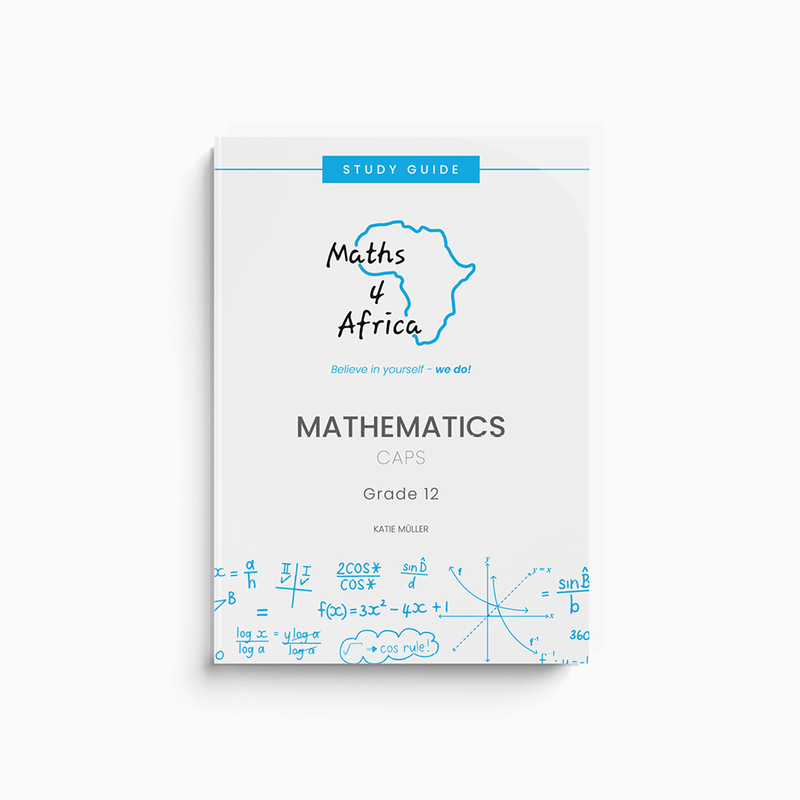
Mathematics Study Guide - Grade 12
Subject: Mathematics
Language: English
Curriculum: CAPS
Size: A5
In Grade 12, learners are confronted with a lot of new work in addition to revising Grade 11 work before their exams. That is why it is important to keep up and never, ever fall behind. Learners should ensure they understand all new work being taught as they go along. In all of this, the Grade 12 Maths 4 Africa study guide is simply invaluable.
Customize
Product Details
In Grade 12, learners need to be able to work with different formulae for arithmetic and geometric sequences and series in addition to quadratic sequences as studied in Grade 11. Mixed sequences add an extra twist, introducing learners to sigma notation. This is made simple in the Maths 4 Africa study guide, which offers exam-type questions in worked examples. The methods used are carefully explained using helpful tips, colour and highlighting.
∙The concept of inverse functions, including switching between exponential and log functions (also graphically), could be quite daunting. However, this study guide focuses on explaining and illustrating everything in a simple manner, aiming to enable learners to understand the work and apply their knowledge and skills.
∙In financial maths, two important new formulae are introduced. Learners are often confused by tricky time periods about investments and loans. They sometimes feel there seems to be a never-ending range of scenarios and never know when to apply which rule. However, the Maths 4 Africa study guide quickly explains this section in a way that is easy to understand. Each type of problem is offered as a different scenario, and each scenario is worked through as a worked example. All other types of scenarios are covered. In this way, learners can see exactly how one scenario differs from another and how they should deal with each.
∙In the chapter on trigonometry, the different types of trigonometric equations that could be encountered are revised before moving on to compound and double angles. As in the rest of the book, the examples worked on are invaluable, showing learners how to tackle tricky questions.
∙Many learners struggle with three-dimensional trigonometry, finding it difficult to differentiate between triangles in different planes. This chapter in the Maths 4 Africa study guide carefully explains how to solve such problems using colour, helpful tips, and step-by-step explanations.
∙When it comes to polynomials and differential calculus, this book is a real lifesaver. It shows learners exactly how to factorise cubic expressions quickly and easily and deals with applying the remainder and factor theorem in a practical manner. The worked examples include exam-type questions, which learners will find very helpful. In the sections on limits, differentials (derivatives) and gradients, various important examples are included, all accompanied by useful tips and using colour to emphasise important concepts. By doing so, the study guide helps learners understand exactly what to do in each case.
∙Regarding cubic graphs, the Maths 4 Africa study guide highlights areas that learners often seem to struggle with and offers this information in a simple yet effective way, summarising important concepts along the way. Once again, various worked examples are provided to ensure that learners encounter and learn how to deal with all sorts of problems.
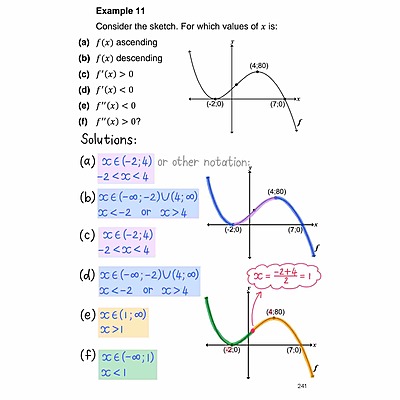
∙Learners often find the link between a graph and the graphs of the original equation’s first and second derivatives quite difficult. This study guide takes time to show learners exactly how these are linked. Colour, concise notes and tips, simple sketches and worked examples based on exam-type questions are used to show the connections between these three graphs. The way this section (as well as the section on tangents to graphs) is explained in a manner which learners can easily understand is invaluable.
∙Furthermore, learners often struggle with applying differentiation in practical problems. The Maths 4 Africa study guide quickly shows learners how simple it is to apply differentiation in various scenarios.
∙In analytical geometry, learners are introduced to circle geometry, which is new to Grade 12. Important and tricky aspects are pointed out to learners, and they are shown exactly how to approach these questions.
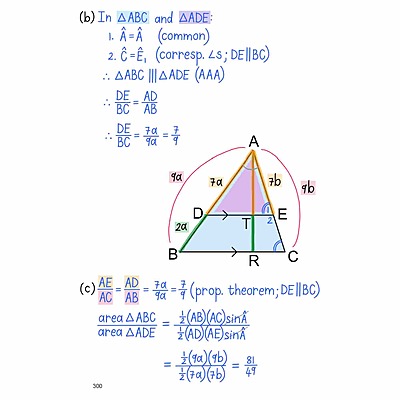
∙When it comes to Euclidean geometry, many learners are quite lost. In Grade 12, learners work with proportionality and similarity and apply the theorems studied in Grade 11. The Maths 4 Africa study guide carefully explains this work using various worked examples. Colour is cleverly used to help explain tricky concepts. Furthermore, sketches in worked examples are repeated in successive subquestions to show learners exactly what is being done in each new subquestion. This way, the writer could effectively use colour to show learners the different steps of solving these problems. A large variety of worked examples are provided, allowing learners to get the hang of this work.
∙In the chapter on statistics, Grade 12 learners are introduced to the concepts of regression and correlation quickly and easily. Using worked examples; they are shown exactly how to use their calculators to find the standard deviation, the correlation coefficient, and the equation of the regression line and how to draw the regression line easily.
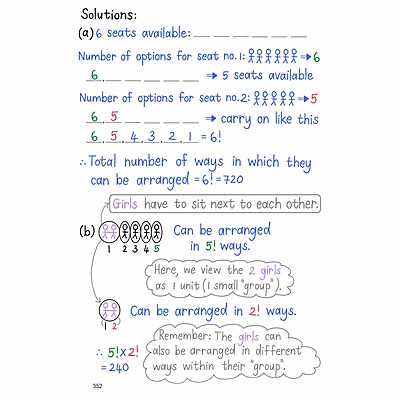
∙The chapter on probability is great. In Grade 12, learners move on to applying the fundamental counting principle and using factorial notation. Learners sometimes find this section tricky, but the Maths 4 Africa study guide makes things easy. Colour, helpful tips, and even clever little sketches help learners understand and apply these new concepts.
∙Furthermore, at the back of the study guide, learners are provided with proof of all the new theorems they need to know for Grade 12, for papers one and 2. (The rest of the proofs they need to know can be found at the back of the Grade 11 Maths 4 Africa study guide.) This means they won’t have to run around in circles to see these proofs before exams, as these can be found at the back of the Grade 11 and 12 Maths 4 Africa study guides. As in all other chapters, colour and helpful tips keep things simple and easily understandable by highlighting important steps.
∙Learners who regularly use the Grade 12 Maths 4 Africa study guide most certainly have an advantage over those who do not.
Specifications
- Book TypeStudy guide
- LanguageEnglish
- CurriculumCAPS
- SizeA5
- Grade12
- Book LanguageEnglish
- Learning TypeStudy Guide

Quicklinks
Contact Information


Follow Us
© 2026 Maths 4 Africa. All rights reserved.


