
 Free courier for 7 books or more
There is a reason why learners are encouraged to take part in sports from a young age. There is a reason why participation in sports is even taken into account when learners apply for tertiary courses, bursaries and jobs later on.
Why does participation in sports matter so much, besides the obvious reason of building a stronger and healthier body?
We know that sports offer many physical, mental and social benefits. For example, participation in sports develops teamwork, because you need to work with all sorts of people to reach a shared goal. It also teaches you resilience. When the going gets tough, the tough gets going. Let’s face it: Every sportsperson faces losses. Many face injuries. A true sportsperson doesn’t give up after losing a match or race. A true sportsperson goes back, practises harder and tries again and yet again.
How wonderful this is, that participation in a “game” could contribute so much to one’s growth and character.
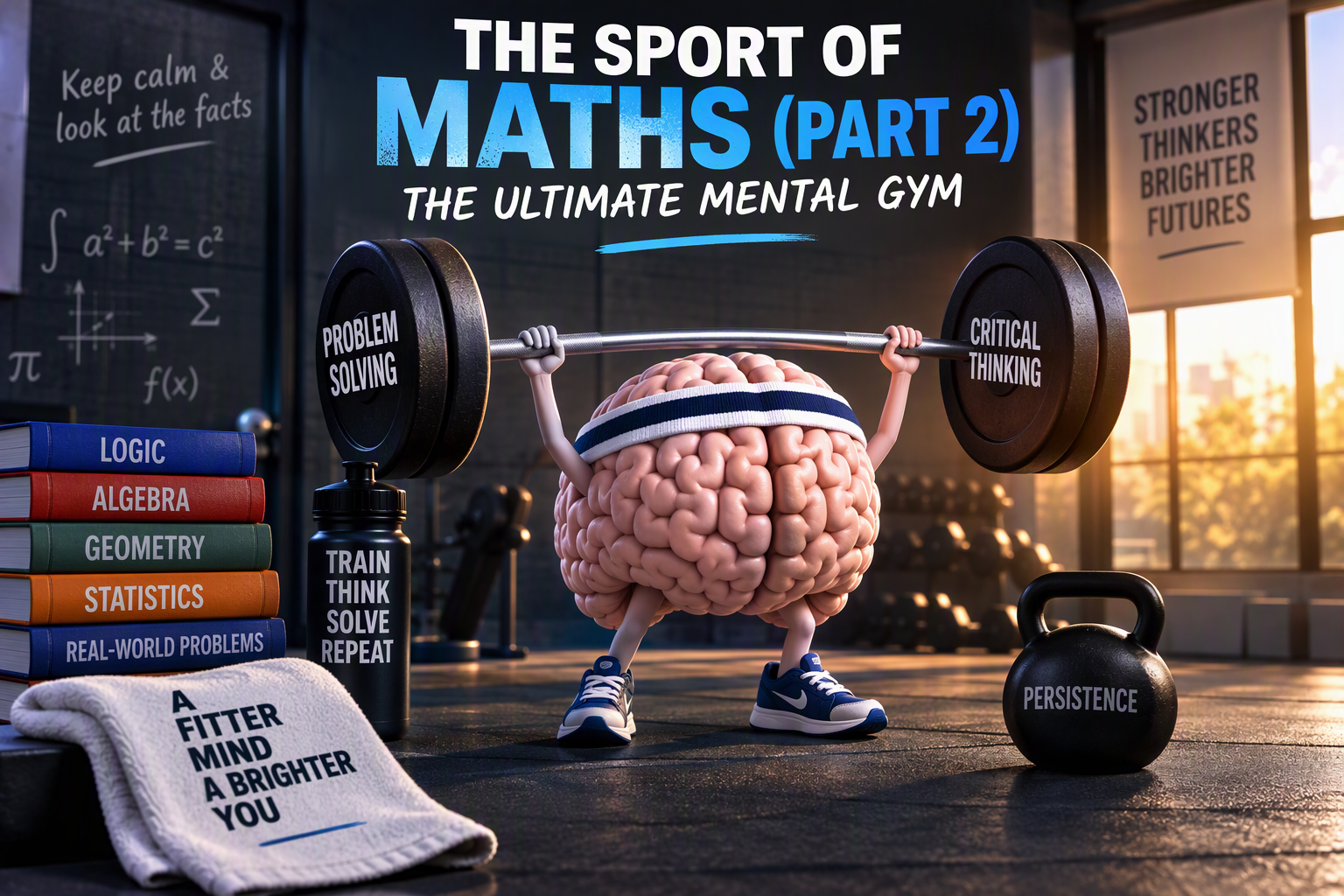
Just as physical sports build a stronger and healthier body, Maths acts as the ultimate endurance sport for the brain. We know that the impact and benefits of sports go far beyond the “game” itself. In the same way, the impact and benefits of Maths go far beyond finding x, learning about angles, studying parabolas, etc. In fact, the subject of Maths is quite unique in its ability to make a profound impact on a person’s general and intellectual growth.
There is a reason why learners are encouraged to spend time on Maths from a young age. There is a reason why having Grade 12 Maths (pure Maths) as a qualification is a basic requirement for such a wide variety of tertiary courses – not only at universities, but also at colleges and other institutions of higher learning. There is a reason why having Grade 12 Maths as a qualification is even taken into account when learners apply for jobs later on.
Although some courses (such as engineering) require technical mathematical knowledge, most value the unique way Maths trains your brain to think, rather than the Maths facts themselves. Rather than just teaching numerical facts, Maths acts as a structural framework for our overall cognitive and personal development. In fact, we can think of Maths as the ultimate mental gym.
Here are some ways in which Maths develops your brain:
Scientific studies show that Maths has a profound impact on your general personal growth by physically developing your brain in all sorts of ways. Because of this, Maths increases your capacity to learn new things and strengthens your long-term memory, amongst other things. This is absolutely fascinating. You can easily find more details on how Maths develops your brain on the internet.
Solving mathematical problems acts as a mental workout. This also improves your ability to switch attention between shifting tasks. In a Maths paper, you often need to switch between solving problems in algebra, geometry, number patterns, statistics, probability, etc. within minutes. Your brain works differently for all of these different sections or tasks. This teaches you to quickly and efficiently switch your attention between different tasks in real life, too.
In Maths, you are taught to analyse the information at hand quickly yet carefully and calmly, consider what you need to find or solve, and then make decisions on how to best reach a solution. This sharpens your decision-making skills in the real world as well, because it teaches your brain how to approach and manage problems.
Maths also helps you process complex information more efficiently. We all know that sometimes, it feels as if you simply don’t have enough information at hand when you first look at a complex Maths problem. But once you start analysing what little information is provided, you find yourself discovering all sorts of hidden information which will help you solve the problem. This teaches your brain to calmly analyse whatever information is provided quickly and carefully before making decisions on how to solve a problem. Because you regularly practise this in Maths, it becomes a principle you will automatically apply to real-life problems, whether in your personal or social life or your job.
Studies show that people with mathematical training take a more measured, objective approach to solving everyday, non-math problems or dilemmas. Because Maths often involves trial, error and frequent failure before reaching a solution, it trains you to stay calm and manage frustration constructively. You learn how important it is to maintain a positive mindset, and not to give up when you don’t succeed at first.
When the going gets tough, the tough gets going. Maths fosters emotional resilience. It teaches you to accept that setbacks and stressful situations are normal parts of life. Just as a true sportsperson doesn’t give up after losing a match or race, Maths teaches you not to give up after doing badly in a test or exam. It teaches you to go back, practise more and try again and yet again.
Maths develops your mind in so many wonderful ways that I could write a book on this, but in the end, it all comes down to the fact that Maths is the ultimate gym for your brain.
Use it.


